
The hospitality industry is deeply connected with the external dynamics of the world, & nowhere is this more apparent than in South Asia, where recurring tensions between India & Pakistan have periodically challenged the sector. Each escalation, whether through conflict, terror incidents, or diplomatic standoffs-has had immediate & far-reaching effects on tourism flows, hotel occupancy, event scheduling, & business confidence. Understanding these patterns offers valuable insights into the resilience and adaptability of the hospitality industry.
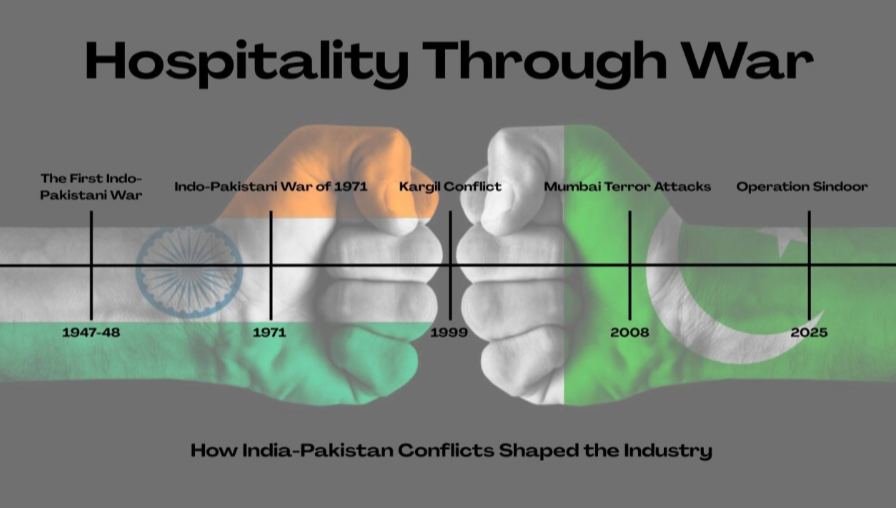
To better understand these patterns, let us examine key moments in the India-Pakistan relationship & their impact on the hospitality sector through a timeline of significant events.
1947-48: The First Indo-Pakistani War: The partition of India & the ensuing conflict over Kashmir brought the region’s tourism to a near standstill. The hospitality sector, still developing at the time, faced significant setbacks due to instability & restricted movement.
Indo-Pakistani War of 1971: During this period, foreign tourist arrivals dropped from 2.02 million in 1970 to 1.96 million in 1971, according to ANAROCK. Delhi’s hotel occupancy fell below 45%, & the Indian Hotels Company(IHC) reported double-digit revenue declines, especially in conflict-affected areas like Srinagar. Mumbai’s property registrations decreased by nearly 10%. Commercial real estate development slowed, & retail footfall in cities such as Delhi & Kolkata declined. Recovery was gradual as peace and economic stability returned.
1999: Kargil Conflict: The Kargil War caused considerable short-term disruption in the hospitality & real estate industry. North India experienced hotel cancellations of 20–30% during the three-month conflict, with hotels in Delhi & Kashmir especially affected, & MICE (Meetings, Incentives, Conferences, & Exhibitions) bookings cancelled in large numbers. Despite the immediate impact, the market recovered quickly due to a more resilient economy. Notably, after peace was restored, Kargil saw a surge in tourism, with annual tourist footfall doubling to 44,000 by 2003 compared to pre-war numbers.
The hospitality industry is deeply connected with the external dynamics of the world, & nowhere is this more apparent than in South Asia, where recurring tensions between India & Pakistan have periodically challenged the sector. Each escalation, whether through conflict, terror incidents, or diplomatic standoffs-has had immediate & far-reaching effects on tourism flows, hotel occupancy, event scheduling, & business confidence. Understanding these patterns offers valuable insights into the resilience and adaptability of the hospitality industry.
To better understand these patterns, let us examine key moments in the India-Pakistan relationship & their impact on the hospitality sector through a timeline of significant events.
1947-48: The First Indo-Pakistani War: The partition of India & the ensuing conflict over Kashmir brought the region’s tourism to a near standstill. The hospitality sector, still developing at the time, faced significant setbacks due to instability & restricted movement.
Indo-Pakistani War of 1971: During this period, foreign tourist arrivals dropped from 2.02 million in 1970 to 1.96 million in 1971, according to ANAROCK. Delhi’s hotel occupancy fell below 45%, & the Indian Hotels Company(IHC) reported double-digit revenue declines, especially in conflict-affected areas like Srinagar. Mumbai’s property registrations decreased by nearly 10%. Commercial real estate development slowed, & retail footfall in cities such as Delhi & Kolkata declined. Recovery was gradual as peace and economic stability returned.
1999: Kargil Conflict: The Kargil War caused considerable short-term disruption in the hospitality & real estate industry. North India experienced hotel cancellations of 20–30% during the three-month conflict, with hotels in Delhi & Kashmir especially affected, & MICE (Meetings, Incentives, Conferences, & Exhibitions) bookings cancelled in large numbers. Despite the immediate impact, the market recovered quickly due to a more resilient economy. Notably, after peace was restored, Kargil saw a surge in tourism, with annual tourist footfall doubling to 44,000 by 2003 compared to pre-war numbers.
The hospitality industry is deeply connected with the external dynamics of the world, & nowhere is this more apparent than in South Asia, where recurring tensions between India & Pakistan have periodically challenged the sector. Each escalation, whether through conflict, terror incidents, or diplomatic standoffs-has had immediate & far-reaching effects on tourism flows, hotel occupancy, event scheduling, & business confidence. Understanding these patterns offers valuable insights into the resilience and adaptability of the hospitality industry.
To better understand these patterns, let us examine key moments in the India-Pakistan relationship & their impact on the hospitality sector through a timeline of significant events.
1947-48: The First Indo-Pakistani War: The partition of India & the ensuing conflict over Kashmir brought the region’s tourism to a near standstill. The hospitality sector, still developing at the time, faced significant setbacks due to instability & restricted movement.
Indo-Pakistani War of 1971: During this period, foreign tourist arrivals dropped from 2.02 million in 1970 to 1.96 million in 1971, according to ANAROCK. Delhi’s hotel occupancy fell below 45%, & the Indian Hotels Company(IHC) reported double-digit revenue declines, especially in conflict-affected areas like Srinagar. Mumbai’s property registrations decreased by nearly 10%. Commercial real estate development slowed, & retail footfall in cities such as Delhi & Kolkata declined. Recovery was gradual as peace and economic stability returned.
1999: Kargil Conflict: The Kargil War caused considerable short-term disruption in the hospitality & real estate industry. North India experienced hotel cancellations of 20–30% during the three-month conflict, with hotels in Delhi & Kashmir especially affected, & MICE (Meetings, Incentives, Conferences, & Exhibitions) bookings cancelled in large numbers. Despite the immediate impact, the market recovered quickly due to a more resilient economy. Notably, after peace was restored, Kargil saw a surge in tourism, with annual tourist footfall doubling to 44,000 by 2003 compared to pre-war numbers.
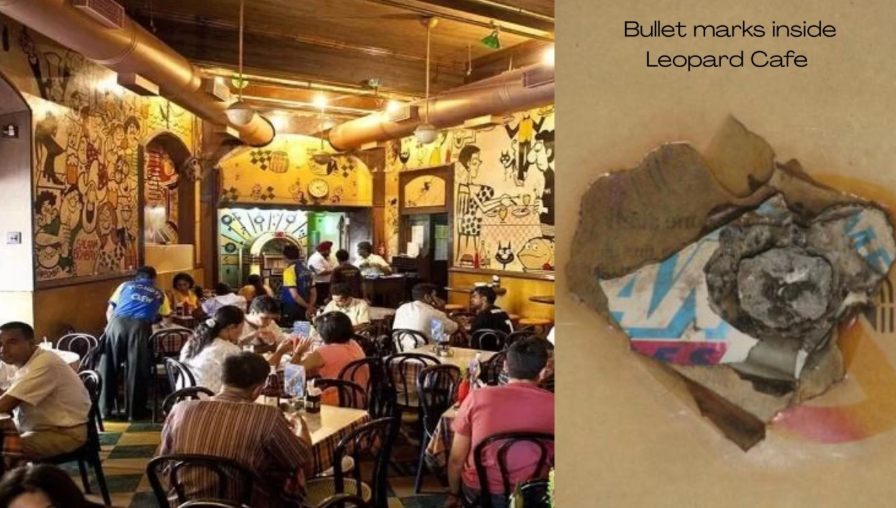
Bullet marks from the 26/11 attacks preserved at Leopold Cafe
The Leopold Cafe, another key location targeted during the attacks, chose to preserve bullet marks & shattered glass as a living memorial 1to the tragedy. The cafe still displays over 19 bullet hole marks, serving as a poignant reminder of the attack & a symbol of resilience.
The hospitality industry responded by implementing enhanced security measures & crisis management protocols, gradually restoring traveller confidence & setting new safety standards.
2025: Operation Sindoor: The most recent escalation, triggered by the Pahalgam attack, has swiftly & severely impacted the hospitality sector. Over 50% of hotel bookings in major cities such as Mumbai, Delhi, Bangalore, & Chennai were cancelled within days, as companies issued travel advisories & suspended major events, including the Indian Premier League.
The industry faces a projected 40% business slump for May, with leading chains like Indian Hotels Company (IHCL) & Ventive Hospitality reporting daily EBIT losses of ₹1–1.5 crore and ₹50 lakh, respectively, due to the drop in inbound international tourism.
In Kashmir, where tourism supports a significant portion of the population, arrivals have dropped sharply, & hotels have resorted to offering discounts of up to 70% to attract guests. The exodus of migrant workers from Jammu & Kashmir & Punjab has further strained hotel operations, with up to 50% of hospitality staff in Jammu reported to have left in the wake of the crisis. Stock prices of major hotel chains have also fallen by up to 7% since the conflict escalated.
Conclusion
Therefore, each conflict has brought unique challenges, from operational disruptions to declining revenues & labour shortages. While geopolitical tensions can cause significant short-term setbacks, learning from past experiences and prioritising safety, flexibility, & guest confidence, the sector is well-positioned to navigate future uncertainties, if any.